
“Ask anyone who has seriously studied yoga in India, and they will say the same thing. When it comes to the best yoga schools in India, there is Rishikesh, and then there is everywhere else. Not because the city is prettier or cheaper, but because the practice here runs deeper, older, and truer than anywhere else on earth.”
I have trained in studios across three continents. I have completed a yoga teacher training course in Rishikesh twice, and once in Mysore. The difference is not about which city has better mats or newer facilities. It is about what happens to you when the environment itself is part of the curriculum.
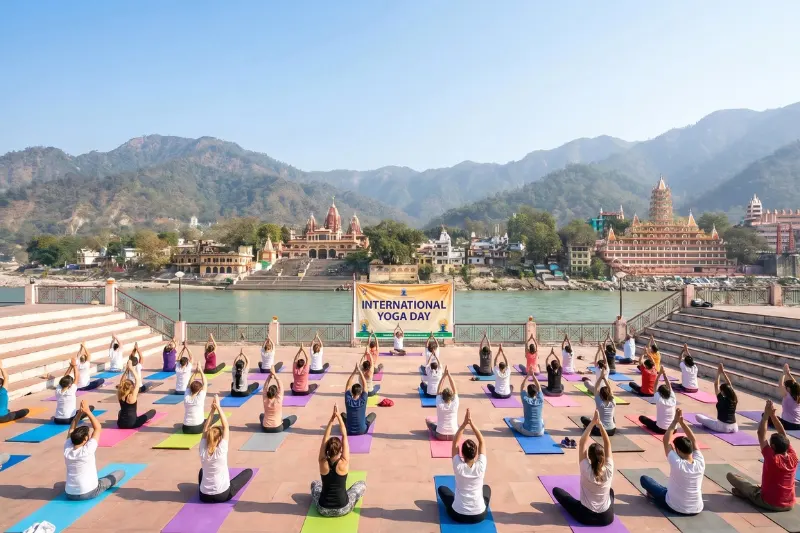
Every June 21st, on Yoga Day June 21, the world watches Rishikesh come alive with the global yoga celebration that draws thousands of practitioners to its ghats. But the real story is what happens the other 364 days of the year.
KEY TAKEAWAYS
- Best Yoga Schools in India are concentrated in Rishikesh due to 80+ years of unbroken teaching lineage
- Yoga Teacher Training Course in Rishikesh follows traditional parampara, not compiled weekend curricula
- Yoga School in Rishikesh offers total immersion, a 24-hour practice environment unavailable elsewhere
- International Yoga Day celebrations here are unlike anywhere else, rooted in a living tradition
- Rishikesh Yoga Certification is internationally recognised and backed by Yoga Alliance accreditation
- The Ganga, the Himalayas, and ashram culture form an environment that accelerates genuine practice.
The History Behind the Best Yoga Schools in India
Rishikesh sits at the point where the Ganga leaves the Himalayas and enters the plains. That geography is not incidental. For centuries, it has drawn saints, scholars, and seekers. Swami Sivananda established the Divine Life Society here in 1936. The Bihar School of Yoga traces its roots to this same geography. When Maharishi Mahesh Yogi taught the Beatles here in 1968, Rishikesh landed on a global map it has never left.
But what matters more than the famous names is the unbroken chain of transmission they created. Teachers trained under masters who trained under masters. That chain is alive in every serious yoga school in Rishikesh today. It does not exist anywhere else in India to the same degree.
When you join a yoga TTC in Rishikesh, you are not learning from a curriculum assembled from books and trend reports. You are sitting inside a living tradition. That distinction changes everything about what you absorb.
Parampara: The Lineage That No Studio Can Replicate
The Sanskrit word parampara means “one after another”, the guru-to-student chain of knowledge. In traditional yoga in India, a teacher does not just teach poses. They transmit a quality of attention, a relationship with breath, a way of sitting with discomfort, that took their own teacher years to pass on.
A teacher trained inside the parampara does not teach from notes. They teach from lived experience. The gap between those two things is enormous. And that gap is exactly why a yoga teacher training in Rishikesh from a lineage-based school is categorically different from a 200-hour course at a metropolitan studio.
Authentic yoga gurus in Rishikesh have practiced for 20, 30, sometimes 50 years. They chose to live and teach in a small mountain town when they could have commanded better fees in any major city. That choice itself tells you something.
What a Yoga TTC in Rishikesh Actually Teaches You
Here is where most yoga travel content gets it wrong. People expect a Rishikesh training to be a fitness boot camp. What they find instead is a complete reconfiguration of how they think about the body, the breath, and the mind.
The curriculum at serious schools covers things most studios never approach. Pranayama is a standalone practice with its own sequencing and contraindications. Patanjali’s Yoga Sutras are taught as a living framework, not as assigned reading. Shatkarmas are performed before dawn. Karma yoga is practiced by serving the ashram community.
The benefits of yoga taught here go far beyond flexibility. Students leave with tools for yoga for mental health, including breathwork protocols shown to regulate the nervous system, structured meditation techniques with measurable neurological effects, and a philosophical framework that genuinely changes how they respond to stress.
Classical Hatha and Ashtanga Foundations
Taught from primary texts, not derivative course manuals. Alignment corrections come from decades of embodied practice, not weekend certifications.
Pranayama as Primary Practice
Breathwork in Rishikesh is not a five-minute warm-up. It is a complete practice with its own sequencing, timing rules, and clinical contraindications.
Philosophy from Source Texts
The Upanishads, Bhagavad Gita, and Yoga Sutras are taught by scholars trained in Sanskrit. Not by instructors reading English translations.
Yoga for Mental Health and Nervous System Regulation
Evidence-based pranayama and meditation protocols with measurable effects on cortisol, anxiety scores, and sleep quality.
Rishikesh vs Metro Studios: An Honest, Direct Comparison
This is not about dismissing excellent teachers working in cities across India. But when someone asks why they should invest time in a yoga school in Rishikesh rather than a well-reviewed studio in their home city, the differences are real and worth naming clearly.
RISHIKESH YOGA SCHOOL
- Teachers with 20-50 years of personal daily practice
- Parampara transmission from an unbroken lineage
- Total 24-hour immersion, yoga is the environment
- Ancient texts taught by actual Sanskrit scholars
- Ashram lifestyle reinforces every single teaching
- Internationally recognised Rishikesh yoga certification
- International Yoga Day lived as a real community event
METRO STUDIO TRAINING
- Instructors are often trained for 5-10 years prior to
- Curriculum assembled from published manuals
- Training ends the moment the class finishes
- Philosophy is treated as an optional weekend module
- City life continues and competes with the practice
- More accessible for those with limited time
- Yoga Day is typically a marketing event
The metro studio is the right choice for some people. But when the question is where to earn a Rishikesh yoga certification that carries genuine weight with employers, studios, and students worldwide, the comparison is not close.
The Environment That Makes Yoga in Rishikesh Irreplaceable
You cannot understand why yoga in Rishikesh is different without understanding the town itself. No other city can replicate what Rishikesh does environmentally, no matter how accomplished its teachers are.
Wake up at 5 am in Tapovan, the quiet neighbourhood above Laxman Jhula, where most serious schools are based. The air is cold and sharp. The Ganga is audible from almost every ashram window, not as background noise, but as a sustained low roar that somehow quiets the mind rather than distracting it. Temple bells start before dawn. Incense and woodsmoke drift through practice halls still lit by single bulbs.
This is what International Yoga Day celebrations look like here. Not a pop-up class in a park. Hundreds of practitioners on the ghats at sunrise, moving through sun salutations as the mist rises off the river. Ashrams open to anyone who wants to participate. Sanskrit chanting echoes off stone walls. You do not forget it.
There is a reason the ancient teachers chose this specific place. The environment becomes the teacher. The river teaches impermanence. The mountains teach stillness. You practice between the two, and something starts to make sense that the texts could only gesture at.
How to Celebrate Yoga Day in Rishikesh: A Practical Guide
If you are planning around Yoga Day, June 21, here is how the global yoga celebration actually unfolds in Rishikesh:
- Sunrise on the Ghats: The main celebrations begin before 6 am at Triveni Ghat and Parmarth Niketan. Free entry, open to all abilities.
- Ashram Open Days: Most ashrams offer free classes, talks, and guided meditation throughout the day. No prior booking required.
- Ganga Aarti in the Evening: The daily Ganga Aarti turns into a big event on Yoga Day with hundreds of people gathered to offer holy lamps to the river, tagging along for the ritual.
- Philosophy Sessions: Some schools offer afternoon talks on the Yoga Sutras and what yoga was like in India traditionally. Even if you’re not enrolled, these are worth attending.
Learning how to celebrate Yoga Day in Rishikesh is different from celebrating it anywhere else in the world. Here, the day is not an excuse to post a photo. It is a continuation of a practice that has been running in this valley for centuries.
The Mental Health Benefits of Yoga Training in Rishikesh
The benefits of yoga taught in Rishikesh schools are well-documented. But what students consistently report after a serious yoga TTC in Rishikesh is something harder to put on a brochure: a fundamental shift in how they relate to their own minds.
Yoga for mental health is not a marketing phrase here. The pranayama practices taught in Rishikesh schools, specifically Nadi Shodhana, Bhramari, and Kapalabhati sequences, have a measurable effect on the parasympathetic nervous system. Students report reduced anxiety, improved sleep, and a quieter internal commentary within two to three weeks of consistent practice.
The benefits of yoga taught in Rishikesh schools are well-documented. But what students consistently report after a serious yoga TTC in Rishikesh is something harder to put on a brochure: a fundamental shift in how they relate to their own minds.
Yoga for mental health is not a marketing phrase here. The pranayama practices taught in Rishikesh schools, specifically Nadi Shodhana, Bhramari, and Kapalabhati sequences, have a measurable effect on the parasympathetic nervous system. Students report reduced anxiety, improved sleep, and a quieter internal commentary within two to three weeks of consistent practice.
Who Should Choose a Yoga School in Rishikesh?
Rishikesh is not the right choice for everyone, and honesty here serves you better than enthusiasm.
Days typically begin at 5:30 am and end at 9 pm. The diet is simple, mostly Sattvic vegetarian food. The schedule is rigid. The self-confrontation that happens during immersive residential practice is real and sometimes uncomfortable. You are not on holiday. You are in training.
But if you want to understand what yoga actually is, not the wellness industry’s version, but the complete, undiluted tradition, then a yoga school in Rishikesh is the most efficient place on earth to get there. Everything that makes yoga genuinely transformative: the tradition, the authentic yoga gurus, the environment, and the community, is concentrated here in a density that simply does not exist anywhere else.
That is not mysticism. It is geography and history doing what they have always done.
Theyogishouse, Yoga School in Rishikesh
If this inspired you to get started seeking a yoga teacher training in Rishikesh, check out Theyogishouse, the best yoga school in Rishikesh. The school provides holistic Programs, such as 100-hour yoga TTC in Rishikesh, 200-hour yoga TTC in Rishikesh, and special courses like aerial yoga, prenatal yoga TTC in Rishikesh, and sound healing yoga TTC in Rishikesh. Situated in the calm Himalayas and very near to the holy River Ganga, Theyogishouse is the perfect serene place for an immersive learning experience along with shatavari-based personal development and professional certification.
Frequently Asked Questions About Yoga Teacher Training in Rishikesh
Q1. Why is Rishikesh considered the Yoga Capital of the World?
Rishikesh earned this title through centuries of yogic tradition, not marketing. It is where Swami Sivananda founded the Divine Life Society in 1936, where the first systematic yoga teacher training programmes were formalised, and where unbroken lineage-based teaching still thrives today. UNESCO and the global yoga community recognise Rishikesh as the birthplace of structured yoga education.
Q2. What is the best time to join a yoga TTC in Rishikesh?
February to April and September to November offer the most comfortable climate for intensive practice. The summer heat from May to July can be intense, though many serious schools maintain year-round schedules. International Yoga Day on June 21st draws large groups, so booking around that period requires early planning.
Q3. How long does a yoga teacher training course in Rishikesh take?
Standard programmes run for 28 days for a 200-hour certification and 45 to 60 days for a 300-hour programme. Shorter immersions of 7 to 14 days exist for non-certification retreats. For a Rishikesh yoga certification recognised by Yoga Alliance internationally, the 200-hour programme is the minimum requirement.
Q4. Is yoga in Rishikesh suitable for complete beginners?
Yes, provided you choose the right school. Many yoga schools in Rishikesh offer beginner-friendly 200-hour programmes specifically designed for people who are new to structured practice. The environment supports beginners well because the ashram lifestyle, simple food, and early schedule naturally quieten the nervous system and accelerate learning.